
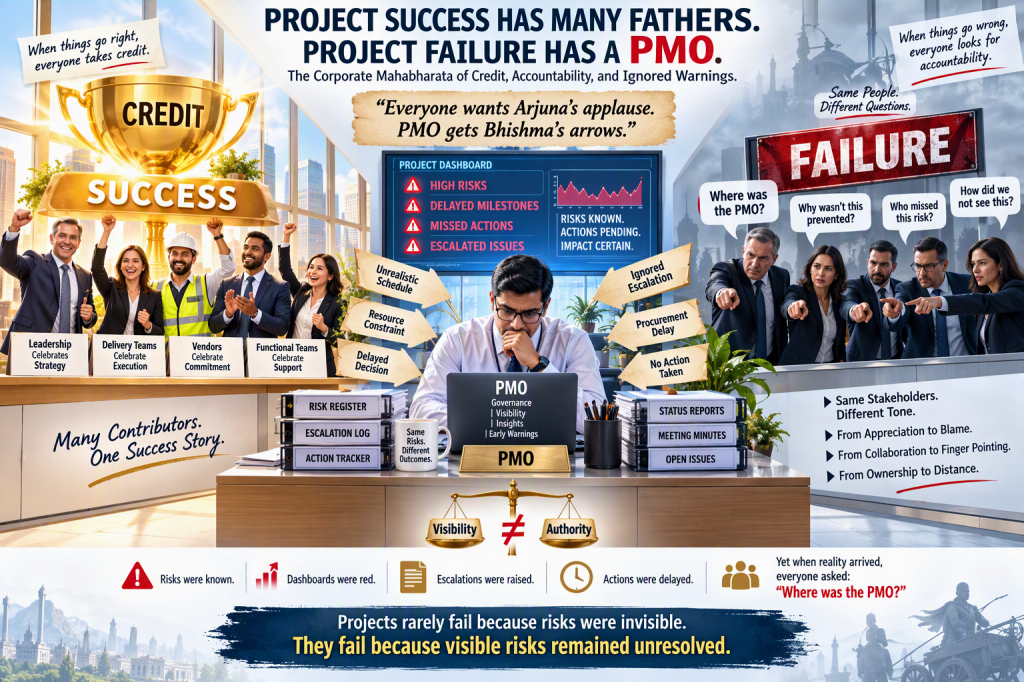
Project Success Has Many Fathers. Project Failure Has a PMO.
The Corporate Mahabharata of Credit, Accountability, and Ignored Warnings. “In corporate life, everyone wants Arjuna’s applause. PMO gets Bhishma’s arrows.”
Most professionals read the Mahabharata as a story of heroes, warriors, and an epic war. Yet, when viewed through the lens of leadership and project governance, it reveals something far more profound. The Mahabharata is not fundamentally a story about how wars are fought. It is a story about how wars become inevitable. The tragedy of Kurukshetra did not begin when the first arrow was released. It began years earlier in the royal court of Hastinapur. The warning signs were visible. The risks were known. The consequences were predictable. Bhishma saw them. Vidura warned against them. Krishna cautioned against them. Yet the kingdom continued its journey toward catastrophe. Not because information was unavailable. Not because nobody understood the risks. But because confronting reality was less comfortable than postponing it. The more I reflect on modern organizations, the more I believe every large project follows a remarkably similar pattern.
The Battle Behind Every Project
Let me start with a confession. After spending years around projects, programs, reviews, dashboards, escalations, recovery plans, status meetings, and leadership discussions, I’ve come to believe that the biggest battle in organizations is not about execution.
When we discuss projects, we usually focus on execution. We talk about schedules, budgets, manpower, contracts, risks, and deliverables. These are tangible aspects of project management and naturally receive the most attention. However, there is another battle running alongside every project. It is less visible but often far more intense. It is the battle for credit.
As long as deliverables are being achieved and milestones are being celebrated, every stakeholder’s contribution becomes visible. Leadership highlights strategic direction. Functional teams emphasize the support they provided. Delivery teams showcase their execution capabilities. Vendors, consultants, and contractors demonstrate commitment to success and rightly so. Successful projects require collective effort.
The dynamic changes, however, when schedules begin slipping, budgets come under pressure, risks materialize, and recovery plans fail to produce results. Suddenly, celebrations are replaced by explanations. Ownership becomes less visible. The enthusiasm that accompanied success begins to fade and in many organizations, one familiar question eventually emerges: “Where was the PMO?” The irony is difficult to ignore. The PMO does not appoint contractors. It does not sanction budgets. It does not approve designs. It does not execute construction or deploy manpower. Yet it often finds itself at the center of discussions when projects encounter difficulty. Somehow, success becomes collective while failure becomes administrative.
Why PMO Is the Bhishma of Corporate Life
Among all the characters in the Mahabharata, Bhishma perhaps provides the closest parallel to the Project Management Office. Bhishma possessed something incredibly valuable: foresight. Long before the war began, he understood that the kingdom was heading toward conflict. He could see the consequences of unchecked ambition, delayed decisions, and political compromises. He repeatedly advised restraint. He repeatedly encouraged corrective action. He repeatedly warned of the future. Yet despite his wisdom, he could not prevent the outcome. His tragedy was not a lack of intelligence. His tragedy was that wisdom alone could not overcome organizational inertia. Many PMOs live a similar reality. They recognize manpower shortages months before productivity drops. They identify procurement bottlenecks before field activities are impacted. They see unresolved land issues before they become critical path constraints. They highlight unrealistic schedules long before deadlines slip. Every review meeting contains clues. Every dashboard contains signals. Every escalation contains a warning. Yet identifying a risk is fundamentally different from resolving it. Like Bhishma, PMOs frequently possess visibility without authority. They can illuminate the road ahead, but they cannot always compel others to change direction.
Kurukshetra Starts Long Before the Deadline
One of the most profound lessons from the Mahabharata is that wars begin long before they reach the battlefield. Kurukshetra was merely the visible outcome of years of ignored concerns, delayed actions, and poor decisions. The war became inevitable not because nobody recognized the danger, but because too many people believed they still had time. Projects fail in exactly the same way. Very few project failures are genuinely surprising. Most are built gradually through a series of unresolved issues. A delayed approval becomes a delayed procurement. A delayed procurement affects mobilization. Reduced mobilization impacts productivity. Lower productivity affects milestones. The missed milestone creates pressure, and pressure creates poor decisions. By the time the final deadline is missed, the seeds of failure were planted months earlier. This is why post-project reviews often feel strangely familiar to PMOs. The issues being discussed are rarely new. The risks were logged. The actions were assigned. The concerns were escalated. The warnings were documented. The failure simply arrived on the date everyone hoped would never come.
The Vidura Syndrome: Speaking Truth to the Unwilling
If Bhishma symbolizes foresight, Vidura symbolizes uncomfortable truth. Vidura repeatedly advised Dhritarashtra to confront reality. He challenged flawed assumptions. He warned against emotional decision-making. He advocated for corrective action before conflict became unavoidable. Yet Vidura faced a challenge familiar to many governance professionals. People rarely reject the truth because it lacks merit. They reject it because it is inconvenient. Modern organizations often behave similarly. Leaders ask for transparency. They ask for accurate reporting. They ask for visibility into risks and issues. PMOs are expected to provide precisely this information. However, transparency becomes less appealing when it exposes uncomfortable realities. A red dashboard threatens confidence. A missed commitment demands accountability. A risk escalation forces action. Suddenly, the conversation shifts from the issue itself to the person raising the issue. PMOs often discover that people who request honesty do not always appreciate its consequences. Like Vidura, they become unpopular not for being wrong, but for being right too early.
The Corporate Dice Game
Among all the events in the Mahabharata, the game of dice may be the most relevant to project leadership today. What made the dice game dangerous was not gambling itself. It was the belief that consequences could always be managed later. Every organization has its own version of the dice game. A commitment is accepted without resources. A schedule is approved despite unrealistic assumptions. A dependency is ignored because immediate escalation feels uncomfortable. A risk is tolerated because mitigation requires difficult conversations.
A status is reported as “amber” when everyone knows it is already red. For a brief period, nothing appears wrong. In fact, things may even look positive. But eventually reality demands payment. The fundamental problem is that organizations often mistake optimism for strategy. Hope is valuable. Confidence is important. Ambition drives growth. Yet none of them replace planning, governance, or decisive action. Hope has never closed a risk. Hope has never recovered a delayed project. Hope has never resolved a critical dependency. Only action does.
Why Visibility Often Becomes a Burden
Most organizations claim to value transparency. What they often underestimate is the discomfort transparency creates. Visibility exposes delays. Visibility exposes weak decisions. Visibility exposes unrealistic commitments. Visibility exposes accountability gaps. Consequently, the greatest resistance is often directed not at the problem, but at the visibility of the problem. This creates a peculiar challenge for PMOs. Their value comes from identifying concerns before they become crises. Yet by doing so, they inevitably become associated with negative information. Over time, PMOs may find themselves viewed as pessimistic, bureaucratic, or overly cautious.
In reality, they are simply doing the job they were established to do. The purpose of governance is not to make people comfortable. The purpose of governance is to prevent organizations from being surprised by reality.
Why PMO Gets Bhishma’s Arrows
One image from the Mahabharata remains particularly powerful. Bhishma, the wisest man in the kingdom, lies on a bed of arrows while witnessing the consequences of decisions he had warned against for years.
It is difficult to find a more fitting metaphor for many PMO professionals. The PMO raises the earliest concerns. It maintains the risk register. It tracks commitments. It records decisions. It facilitates escalations and continuously highlights unresolved issues.Yet when problems finally materialize, the PMO is often called upon to explain the situation. The people who identified the risk become responsible for discussing the risk. The people who documented the warning become associated with the warning. The people who created visibility become linked to the failure. Meanwhile, many of those who ignored the warning remain comfortably distant from the discussion. This is why PMOs rarely identify with Arjuna. Arjuna won the war and received the glory. PMOs often identify more closely with Bhishma, watching outcomes unfold exactly as predicted while carrying a disproportionate share of the scrutiny.
The PMO Every Organization Should Fear
Contrary to popular belief, organizations should not fear a PMO that escalates risks aggressively. They should fear a PMO that has stopped escalating altogether. A PMO that has concluded that bad news is unwelcome. A PMO that has learned transparency creates resistance. A PMO that has stopped challenging assumptions. A PMO that limits itself to reporting rather than governance. At that point, dashboards still look professional. Meetings continue. Reports circulate on time. Everything appears healthy. But governance has quietly disappeared. And when governance disappears, the organization simply begins counting down to its next Kurukshetra.
A Question Every Leader Should Ask
When a project fails, the instinctive question is often: “Why didn’t the PMO prevent this?” Perhaps a better question would be: “How many times did the PMO warn us before this happened?” That question frequently changes the entire narrative. Because most project failures are not caused by a lack of visibility. They are caused by a lack of response to visibility. The issue was known. The risk was discussed. The escalation was raised. The decision was deferred. And reality eventually arrived.
Conclusion: The Lesson We Continue to Ignore
The enduring relevance of the Mahabharata lies not in its description of war, but in its understanding of human behavior. It reminds us that disasters rarely arrive without warning. Catastrophes are usually preceded by signals, indicators, and opportunities to change course. Organizations are no different. Every corporate Mahabharata contains its Arjunas, Krishnas, Duryodhanas, and Dhritarashtras. But it also contains its Bhishmas and Viduras, individuals who continue to speak difficult truths, challenge convenient assumptions, and document uncomfortable realities. More often than not, that role belongs to the PMO. The great irony is that organizations frequently realize the value of governance only after governance was ignored. Because by the time everyone starts listening to Bhishma, the war is no longer a possibility.
It is already underway.
Project Success Has Many Fathers. Project Failure Has a PMO. Everyone wants credit. Nobody wants accountability. Everyone wants Arjuna’s applause. PMO gets Bhishma’s arrows. And the greatest tragedy is not that the warnings were absent. It is that they were present all along. The PMO doesn’t lose the credit war because it lacks visibility; it loses because visibility without authority often turns the messenger into the target.

