
Introduction:
The Day the Risk Register Failed. The phone rings at 8:30 AM.
A critical supplier has missed a delivery. The construction team has stopped work. The client wants an explanation. Senior management demands a recovery plan by evening. Within minutes, calendars are flooded with escalation calls, emails begin flying across the organization, and yet another “war room” is established to save the project. Most project managers have experienced it.
A risk that appeared in a review meeting months ago suddenly becomes today’s biggest problem. A delayed approval, a slipping vendor, a resource gap, or a critical dependency eventually turns into an escalation, a war room, and a recovery plan.
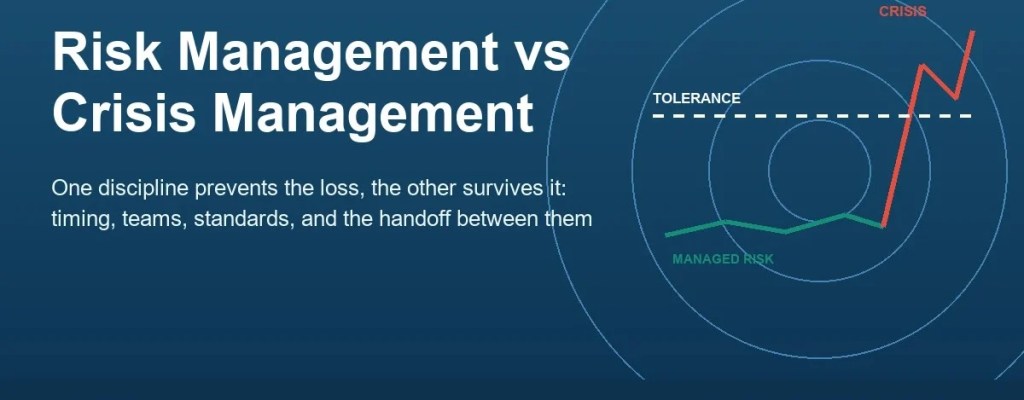
The reality is simple: Most project crises do not arrive unannounced. They begin their journey as unmanaged risks.
Somewhere during execution, risk management quietly gives way to crisis management. This is the paradox of modern project management.
Organizations invest heavily in project planning, governance frameworks, dashboards, risk registers, and review mechanisms. Yet a significant portion of project teams spend their days reacting to problems instead of preventing them. Meetings become escalation forums. Weekly reviews become issue-resolution sessions. Managers become firefighters, constantly moving from one urgent problem to another. Somewhere along the journey, risk management quietly gives way to crisis management.
The Silent Shift from Proactive to Reactive
Project management was never intended to be a profession centered on solving crises. At its core, the discipline is built on foresight, planning, anticipation, and control. The objective is not merely to deliver projects but to navigate uncertainty before uncertainty takes control of the project. Unfortunately, reality often follows a different path.
The Numbers Suggest We Have a Bigger Problem
The data tells an interesting story. According to the Project Management Institute (PMI), organizations with stronger project and risk management practices consistently achieve better project outcomes. Yet major projects continue to struggle. Research cited by Bent found that only 8.5% of projects achieve their planned cost and schedule targets, while McKinsey reported average project cost overruns of around 80% and schedule delays of about 50% for large projects. The issue is rarely a lack of planning. The issue is that identified risks are often not converted into timely actions.
The Real Problem Isn’t Risk Identification
Most organizations are good at identifying risks. Risk registers are created, owners are assigned, and reviews are conducted. The challenge begins when execution starts. Today’s target becomes more important than tomorrow’s threat. Risks remain documented, but mitigation actions lose momentum. Over time, risk management becomes a reporting exercise rather than a management discipline.
Why We Keep Falling Into the Same Trap
Urgent work almost always gets more attention than important work. A problem happening today feels more critical than a risk that may materialize months later. There is also a cultural challenge. Organizations often celebrate teams that recover from crises but rarely recognize teams that prevented a crisis altogether.
As a result, firefighting becomes more visible than prevention.
The Hidden Cost of Firefighting
Crisis management creates activity, but not always value. Every major issue consumes leadership attention, team energy, stakeholder confidence, and countless hours in reviews and escalations. More often than not, the effort required to recover from a problem is far greater than the effort that would have been required to prevent it. Being busy should never be confused with being in control.
The Best Project Managers Think Differently
Exceptional project managers spend less time asking: “How do we recover?” And more time asking: “What could go wrong?” They challenge assumptions, monitor early warning signals, and act before risks become issues. They understand a simple truth:
Every major project issue was once a manageable risk.
A Shift in Mindset
Perhaps it is time to redefine project success. Success should not be measured by the number of crises handled. Success should be measured by the number of crises avoided. After all, the objective of project management was never to create great firefighters. It was to create predictable outcomes despite uncertainty.
Final Thoughts
Despite advances in project-management methodologies, cost overruns and schedule delays remain common across major projects worldwide. The lesson is not that projects have become impossible to manage. The lesson is that organizations often spend far more time managing consequences than managing causes.
The next time a project enters a war room, ask a different question:
“What did we know six months ago that we failed to act on?”
More often than not, the roots of today’s crisis can be traced back to a risk that was identified, discussed, documented, and then quietly forgotten. And that may be the most important lesson in project management.
“A crisis is rarely an unexpected event. More often, it is a known risk that remained unattended for too long.”

