
For decades, project management has been treated as an internal operational discipline—useful for organizing work, aligning teams, and tracking progress. But in the modern world, where economic performance depends on infrastructure, digital transformation, and national programs, project management has taken on a far larger role.
Today, project execution is a macroeconomic driver, shaping productivity, competitiveness, and growth at national and global levels. The data is unmistakable. The Hidden Link Between Projects and National GDP. A country’s economic performance—measured through GDP—reflects the productivity, efficiency, and growth of its industries. What drives these? Projects.
Economists have consistently found that productivity improvements are one of the largest contributors to GDP growth. Capacity expansions, modernization, quality improvement programs, and supply chain revamps are all project-driven transformations that boost industrial output.
In short:
GDP is shaped not just by economic policy, but by the quality and speed of project execution. Where Projects Meet Economics: The Execution Multiplier Effect. Projects have an execution multiplier effect, meaning their economic impact expands far beyond their immediate scope.
1. Projects Are the Engines of Economic Output
Whether it’s highways, metro networks, digital platforms, or renewable energy plants—economic activity emerges from completed projects.
Infrastructure drives GDP directly
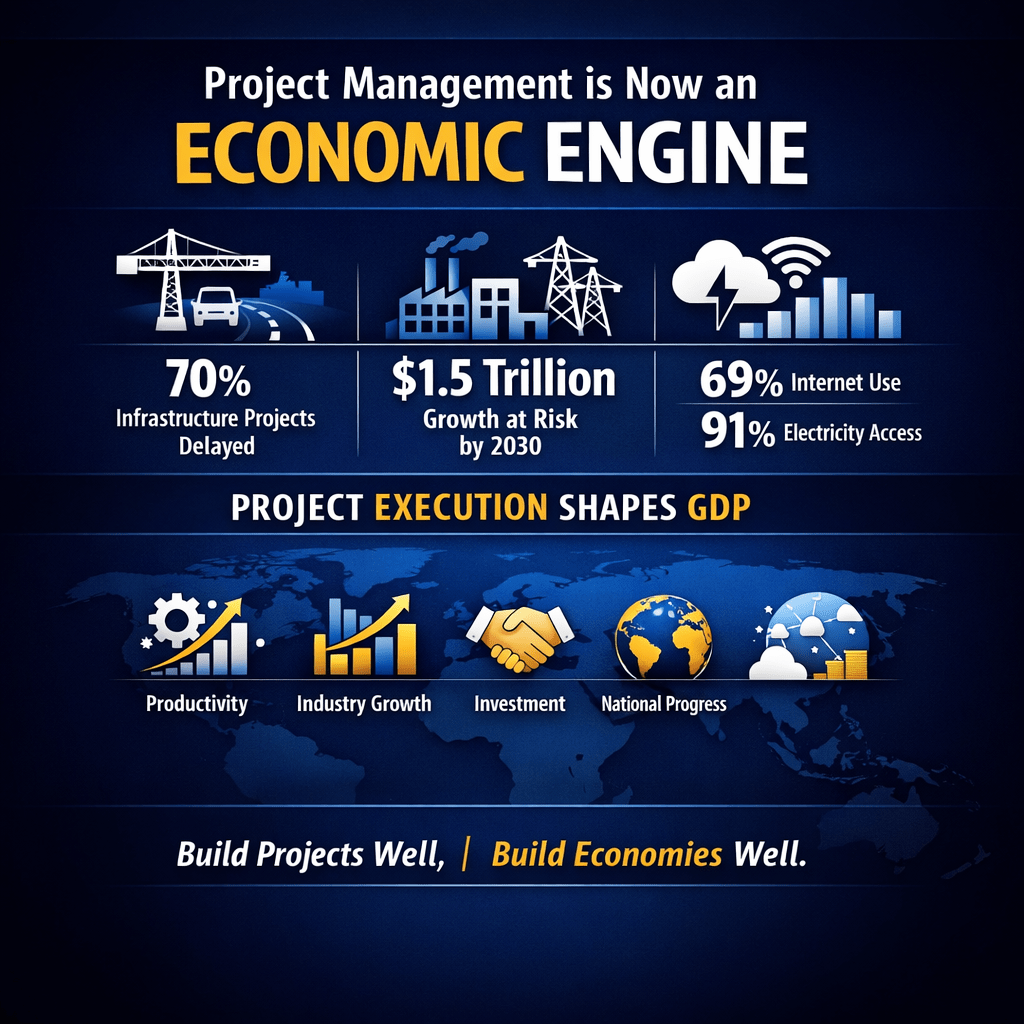
A global analysis of 480 infrastructure projects shows that nearly 70% experience delays, and these delays extend project duration by an average of 73%—far worse than earlier global estimates. These delays covered projects worth US$12 billion, spanning roads, water, sanitation, and education sectors.
When infrastructure slows, so do logistics, mobility, trade efficiency, and job creation—all key contributors to GDP.
Digital transformation boosts productivity
Productivity is one of the strongest contributors to economic growth. Digital projects—cloud, automation, AI, cybersecurity—are the key levers, and global indicators show strong digital readiness. 69.2% of the world’s population now uses the internet (2023), expanding digital participation and commercial activity. Increased access to electricity (91.6% globally in 2023) enables digital and industrial expansion. These are outcomes of thousands of digital and infrastructure projects executed across nations.
Industries expand through project-based investments
Manufacturing modernization, clean energy adoption, and smart logistics happen through well-run capital projects. The better the execution, the faster industries scale.
2. Poor Project Delivery Is a Global Economic Drag
When projects fail, economies lose—sometimes at trillions‑scale.
Mega‑project delays risk $1.5 trillion in lost growth.
A 2025 Mace global study of 5,000+ mega and giga-projects revealed that 11% are at high risk of significant delay or cancellation. These inefficiencies could cost the global economy more than $1.5 trillion in growth by 2030.
Project complexity is exploding
Mega programs have increased 280% since 2010, driven by record public investment and climate-driven infrastructure needs. The U.S. leads (1,663 mega-projects announced), followed by India (729), Saudi Arabia (577), and the UK (484). Growing scale amplifies execution risk.
Low global project success rates worsen economic leakage
According to PMI- and Wellingtone-backed datasets (2025–2026): Only 31% of projects worldwide succeed (on time, on budget, within scope), 50% are challenged & 19% failed outright.
This failure rate means billions—and in some countries, percentage points of GDP—are lost annually due to inefficient execution.
3. How Project Tools Become Economic Instruments
Traditional tools once seen as administrative (Gantt charts, risk registers, WBS) now function as economic assets.
A Gantt Chart = A Timeline of Economic Value
A schedule governs when societies receive:
- New transport capacity
- Digital public infrastructure
- Energy reliability
- Industrial competitiveness
A Budget Baseline = Capital Allocation Efficiency
On-time projects reduce inflationary pressure on public finances. Delays inflate cost, often dramatically—as shown by the 73% average delay seen globally.
A Benefits Realization Plan = Future GDP Contribution
Program outcomes like improved connectivity, reduced transaction costs, or digital adoption directly influence national productivity metrics tracked by institutions like the World Bank.(E.g., Internet penetration at 69.2% and electricity access at 91.6% globally—each driven by executed projects.)
4. The Execution Multiplier Effect: One Project, Many Ripples
Every well-executed project creates layers of economic value:
- Direct & Indirect jobs (construction, engineering, IT, supply chain, services)
- Induced economic activity (spending, consumption).
- Long-term productivity gains
- Regional development and urbanization
- Higher investor confidence
Infrastructure delays alone show how damaging the reverse effect can be: 43% of projects are delayed, and many by several hundred percent of planned time.
5. The Rise of the Project Economy
The world is shifting from operational work to project-based work. Key trends shaping 2025–2030.
- Hybrid project management models grew 57% in adoption in one year.
- 72% of organizations expect PMOs to expand strategic influence.
By 2026, 80% of PMOs will use AI for decision-making. This marks the evolution of global work structures where value is created primarily through:
- Transformation programs.
- Infrastructure initiatives.
- Digital platforms
- Sustainability projects
- Large-scale modernization efforts.
Economists refer to this as the Project Economy—where nations win or lose economically depending on their execution capability.
6. The Project Manager as an Economic Actor
Today’s project manager is not merely a coordinator—they influence cost efficiency, resource deployment, and the speed of value realization.
- Poor planning inflates national debt.
- Unrealistic scopes delay public benefits.
- Weak risk management amplifies economic shocks.
Given that delays alone could cost $1.5 trillion globally by 2030, project managers are now frontline contributors to economic stability.
Conclusion: Economies Grow When Projects Succeed
GDP is downstream of execution. Poor execution slows economies; strong execution accelerates them. Build Projects Well, Build Economies Well.
The connection between Gantt charts and GDP is no longer symbolic—it’s structural. From Gantt charts to GDP, the line is direct:
- Better infrastructure delivery = higher national productivity
- Faster digital rollout = higher competitiveness
- Efficient capital projects = stronger fiscal health
- Fewer delays = billions saved
Project management is no longer an internal discipline—it is an economic imperative. Economies that execute well will lead the future. Those that don’t will pay the price in lost growth, stalled development, and declining competitiveness.
Project management is not just a delivery function — it is an economic discipline. It is time we treat it that way.
 Project Management